
Mile zero
February 1966

Experience comes from bad judgement. Good judgement comes from experience.
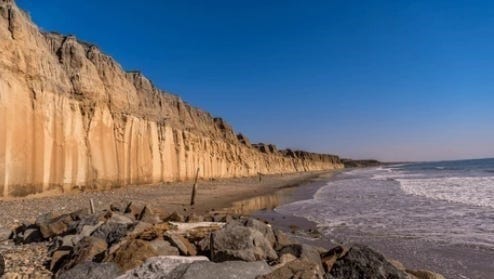
A winter storm in the Pacific drove a north swell down the west coast from Canada to Baja and the waves in Laguna were cresting twenty feet. I wanted to surf a spot called Mile Zero, a mile marker between Dana point and San Clemente on the Pacific Coast Highway, famous among locals for big waves. The whole strip of beach was owned by the Marine Corps at Camp Pendleton and although surfers sneaked in when the waves were good, it was a cat-and-mouse game not getting caught. There was a small fine for trespassing. The bad part was the Marines kept your board. Every now and then, someone got caught.
I lived on Thalia Street and all my friends hung out at Oak Street so I walked over to see if I could get someone with a car go with me. But it was cold and the waves in Laguna were giant ugly walls of water that collapsed with crushing power from the main beach downtown all the way to Brooks Street. They said, “Nah, we’re gonna to drop acid and play some volleyball…maybe go the movies.” Our Man Flint was playing. “Pack it in, you meathead! It’s great acid!”
I’d never ridden a twenty-foot wave. We might get one day a year that broke twenty feet. This was one of them. So I twisted my mother’s arm to go with me. “I’m just going to paddle out for one or two waves, Mom, no more. We'll be home in an hour.”
My mom was always good about stuff. She played catch with me for hours when I was in little league. Taught me how to throw a slider knowing they were illegal for twelve years olds. Cut school when the Yankees were in the series. Drove me on dates when I didn’t have a license. Let me smoke in the house when I was fourteen. A total saint. “Mom. Please?” She agreed to do it but she said it was a stupid idea.
Mile Zero overlooked the Pacific in the middle of miles of lonely steep cliffs. We stood together at the edge, watching lines of huge waves through a grey cloudy winter afternoon like an army of watery infantry. The whump of shore break sounded like heavy artillery. From the heights distance was deceiving. The waves looked smaller, and the main break didn’t look so difficult to reach, but when you’re on the beach it’s like looking at skyscrapers in New York City.
There was a narrow footpath from the top of the cliffs to get down to the beach and there was no way my mother could climb down it. I’d done it a few times and it was tricky for me. “Stay here, Mom. I’ll be right back.” I zipped up my wet suit, put a bar of wax in my teeth and started down the path. It was probably a little after 2:30. She was yelling at me, saying this is a bad idea, “Let’s go home.”
It took me almost thirty minutes just to get through the white water. Finally, I got a lull between sets and forty-five minutes, maybe an hour later, I was outside. It felt like I was in outer space. Huge swells passed beneath me lifting me high in the air. I watched them accelerating towards the beach, breaking with a roar, then sliding into a deep valley of coal black water as the next swell approached. I noticed the cars on the Pacific Coast Highway had their headlights on. My mother was a tiny figure on the cliff watching me, standing motionless.
For half an hour I paddled to hold my spot against the currents, waiting for the shoulder of a lesser wave but they were all shapeless massive walls. By this time, I just wanted to get out of the water but none of them remotely resembled the waves I was watching from the top of the cliff. It was getting dark and windy. The sun was just dipping under a silver line of clouds on the horizon. My hands were numb and luminescent in the fading light. I could barely see the next line of waves forming and panic crept into my gut. “I could be swept out to sea and die out here.”
I started to paddle hard for the first wave of the next set. If I wiped out, I’d have to swim but this was it. The sun was down. "Fuck it," I said, and paddled for my life. A wall of black water picked me up like a leaf in the wind. From the instant I started paddling to catching the crest was probably less than two seconds in time. I leaned forward on my board, maybe four strokes or five and I was vertical pointing straight down 35 or 40 miles an hour. The wave was completely lightless with the twilight behind it. I couldn’t see the bottom of trough, but I could peripherally see the headlights of the cars on PC 101. It was like flying.
I never made it to the bottom of the wave. The wall was accelerating so fast I knew I was going to wipe out, so I didn’t fight it. One way or another I’d be on the beach in a few minutes. I grabbed the rails hoping I could push away from my board, but it whipped into my face as the force of the wave broke over me.
The impact stunned me, and I went deep underwater. The force of it felt like punches, yanking and pulling my arms and legs tumbling violently totally out of control. When I got to the surface, I was desperate for breath. I could taste blood. My nose was crushed but I was halfway in, so I knew I was going to be ok. I rolled over on my back and let the waves push me into the shore break.
My mother had found her way down the cliff, and she got soaked trying to help me onto the beach. I sat in the sand and puked a good amount of blood and salt water and smiled through bloody teeth.
“Thanks, Mom,” I yelled above the wind. She was staring wide eyed at my nose and saying the word "hospital." It was totally dark. No stars. No moon. I could barely read her lips.
“Mom. Calm down. The waves are great!" I joked, trying to relax her. "I’m going get my board and paddle out again.”
She looked terrified and helpless. I put a hand on her shoulder, leaned closer and made eye contact. “I’m ok, Mom. Let's go." She didn't need any encouragement and turned toward the path. I practically had to carry her up it and then come back down for my board, which took another half an hour to find it. She kept yelling, "Leave it! We can come back for it," but I said, "No way." I designed that board, and I worked four months washing dishes after school at the La Paz restaurant to save $100 dollars to buy it from Hobie.
The doctor said I had a broken nose and a bad concussion, but I’d live. I apologized in the car. “I’m sorry, Mom. It was a really dumb idea. You were right.” She didn’t say anything. She just kept driving. That was my last coherent thought. I was exhausted. Everything was shutting down.
When we got out of the car she walked around to my side in several deliberate steps. I stood there thinking she was going to hug me, but she slapped my face with a hard roundhouse. My nose started bleeding again under the plastic beak protector and adhesive tape they put across my cheeks at the hospital. She had to get on her tip toes to do it. It was the only time she ever hit me.
I knew what my friends would be saying at school the next day so, I wrote the whole thing off as a total loss. Ironically the more I said I wished that I hadn’t done it, the more people said they thought it was really cool. “You took off on a twenty-foot wave at Mile Zero in the dark… alone with your mother on the cliffs?” Yeah, I guess I did. It might have been 30 feet. I couldn’t see it.”
A few days later everyone went to mile zero except me. I had a broken nose. Supposedly the waves were the best shape in twenty years. It took me a while to make it up to my mom, but the wonderful part of mothers is they have more forgiveness than their sons can ever use up.
Mrs. Schauwecker, my 11th grade homeroom teacher was genuinely fond of me. She was my English teacher, maybe my favorite teacher ever. When she saw my black eyes and broken nose, she asked me to stay after class to tell her what happened, so I did. She said, "You have a gift for words, Johnny. You should write about it one day." Then she stood up. “That’s all. You can go.”
This has always been one of my many regrets. If I had a do over, I might have made that wave if I tried for an earlier take off.
Mrs. Schauwecker was right, the story made my day.
A great story well told.